Floods, huaicos, storms and crashes in the rain, from one person or two. An AI agent on Amazon Bedrock AgentCore takes the claim by voice, photo and pin, and never decides who is at fault.
Every few years warm Pacific water brings torrential rain to Peru’s northern coast. Rivers overflow, ravines send down huaicos of water and mud, and thousands of homes, shops, farms and cars are damaged in the same weeks.
in losses, one of the century’s strongest El Niños
in losses, about 6.2% of Peru’s GDP
people affected; up to US$3.1B in losses
homes affected, 65,065 people
WMO: El Niño is established, peaking late 2026, impacts into 2027
Sources: Andina and Infomercado (1982–83, 1997–98); IGP and Infomercado citing INDECI (2017); COEN via Gestión (2023); WMO via AFP, September 2026. Loss estimates vary by method. The flooded house is the demo’s example case.
The same warm Pacific water changes weather on several continents. Flood losses come in fast; drought losses come in slowly, as failed crops and dry wells. Both end as claims.
Torrential coastal rain, river overflows and huaicos, as in 1997–98, 2017 and 2023.
Heavy rain and floods, such as Rio Grande do Sul in 2024.
Drier seasons and drought, with low rivers and crop losses.
Guatemala, Honduras, El Salvador and Nicaragua face drought and lost harvests.
Wetter, stormier winters, from California to the Gulf Coast.
Exceptionally intense rainy seasons and floods in 2023–24.
Drought in 2024; all three declared a state of disaster.
Dry, hot conditions and higher bushfire risk.
A weaker monsoon tends to come with El Niño, hitting farm output.
Typical El Niño patterns; each event differs. Sources: WMO; NOAA; 2023–24 El Niño event reports (Zambia, Malawi, Zimbabwe disaster declarations; East Africa rains; Rio Grande do Sul floods). Claimline speaks Spanish and English today.
Floods, storms and wildfires now cause most insured losses worldwide: many mid-size events and many small claims, often from one region in a few days. That is exactly the load a call centre can’t absorb.
Sources: Swiss Re sigma 1/2026; Swiss Re 10-country study via Monitor Mercantil; AP and NBC analyses of NFIP data; AM Best (2026).
After the injury question, Claimline sends two WhatsApp buttons. The choice is saved in code, so no step is skipped, and the same engine serves every line of insurance.
Each person reports from their own phone, in their own language. Claimline compares the versions in code and asks only about what doesn’t match.
A location pin, when it happened, how high the water got, what was damaged and photos. One approval closes the case and the PDF arrives in the chat.
Built today: crashes between two drivers, and floods at home or in a shop. The other claims use the same two paths; each needs its own questions and report fields.
Each fact is labelled AGREED, ONLY_A, ONLY_B or CONFLICT by plain code. Claude only judges whether two free-text values mean the same thing. The agent asks once about each conflict, in neutral words, and never says who is right.
This is the demo’s crash case; Driver A’s words are translated from Spanish here. Both conflicts stay in the joint report, in each driver’s own words, and both drivers approve it.
Text, voice notes (Amazon Transcribe), photos and a location pin, at any hour, in Spanish or English.
The first question is whether anyone is hurt. If so, the agent gives the emergency number and hands the case to a person.
A Strands agent on Bedrock AgentCore asks one question at a time and saves every fact with the person’s own words as evidence.
With two people, plain code compares both versions and the agent asks only about conflicts.
Each person reviews the draft in a WhatsApp Flow. Approving means “this is what I said”, not “I accept the other version”.
The report is built in code as a PDF and sent in the chat. The insurer sees the case on its claims board.
When the rain hits Piura, adjusters see where the damage is, which cases are approved, which have conflicts, and can open any conversation, fact and PDF.
Illustration of the demo’s claims board. The real board in the demo uses a street map.
Claimline is the intake of the claim: it hands each insurer a complete, evidence-backed case for its existing process, and deploys into the insurer’s own AWS account.
A neutral joint report from both drivers, plates typed and checked, conflicts flagged, a PDF for each driver.
Floods, huaicos, storms and fire reported with a pin, the water level, damaged items and photos.
Owners report stock and equipment losses from the shop floor, by voice, without stopping work.
Peru’s state catastrophic crop insurance (SAC) pays S/800 per hectare and planned to cover over 1.6M hectares in 2023–24. Field reports with a pin and photos fit the “Just me” path.
One number for everyone, serverless scale when thousands report at once, cases clustered on a map so adjusters go where the damage is.
A low-cost channel for low-premium policies: no app to install and no call centre, in the chat people already use.
SAC figures: Midagri via El Peruano and Agraria.pe. Claimline doesn’t check coverage, estimate damage, score fraud or pay; it feeds those steps.
In the US, a claim runs through the same stages whether it is a flood with one homeowner or a crash between two drivers with two insurers. Claimline automates the first stages today and hands clean, structured data to the rest.
WhatsApp, voice, photos and a pin, at any hour. One person or both people.
TodaySeparate, neutral interviews; every fact saved with the person’s own words.
TodayJoint or one-person report, approved in a WhatsApp Flow, PDF built in code.
TodayThe board shows every case on a map with status and conflicts, so the right adjuster goes first where it matters.
Feeds itMatch the case to the policy and its exclusions, such as flood, which US homeowners policies usually exclude.
NextA first estimate from photos, water level and damaged items, for the adjuster to confirm.
NextWith two drivers, the adjuster gets both versions and every conflict side by side. Claimline never decides fault.
Feeds itProof-of-loss forms pre-filled, payment status in the chat, and a recovery file for the other insurer.
NextEvery case keeps its location, time, weather, facts with evidence, conflicts and each message, in DynamoDB and S3 in the insurer’s own account. The questions show what that data can answer; the models are future work. Chart is an illustration.
| Finding | What Claimline does |
|---|---|
| Witnesses who talk pick up details they never saw (Gabbert et al., 2003–2006) | Each person reports in their own chat and never sees the other’s answers |
| One loaded verb changes remembered speed (Loftus & Palmer, 1974) | Neutral questions; never suggests a speed, a cause or a fault |
| A chatbot gets more informative answers than a web form (Xiao et al., 2020) | WhatsApp, one question at a time, the person’s own words saved |
| 83% of dissatisfied claimants plan to switch or have switched insurer (Accenture, 2014) | The approval and the PDF arrive in the same chat, in minutes |
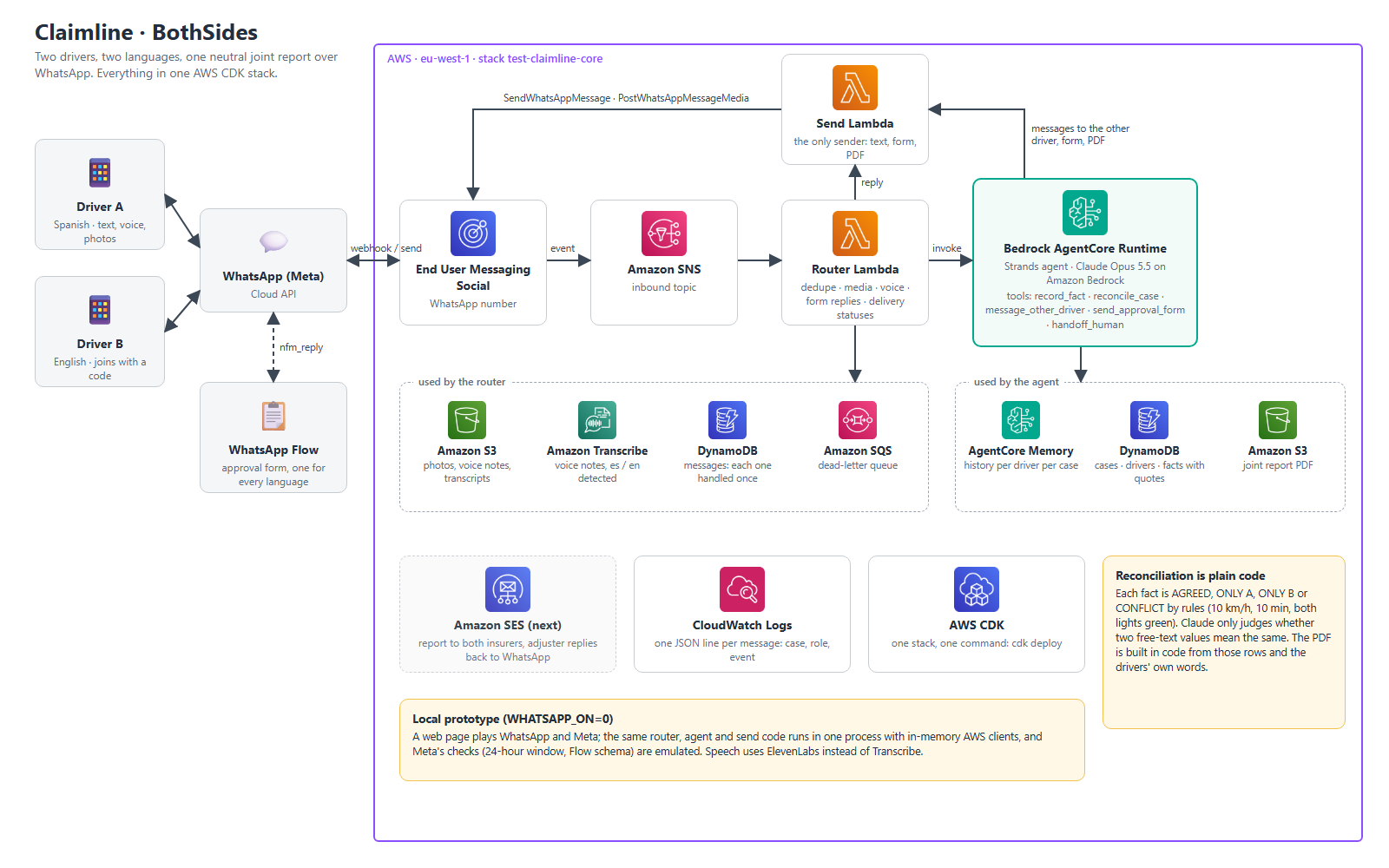
With no traffic it costs almost nothing; in a flood it scales with the claims. The whole stack is AWS CDK, deployed into the insurer’s own account.

Play the El Niño flood or the crash in the rain. The demo runs the real Claimline code; in this public version the agent’s replies are scripted, while the deployed version answers with Claude on Amazon Bedrock.